Rebellion.
'For nonconformity the world whips you with its displeasure.'
- Emerson
Creativity is bringing something new into the world.
Ideas. Suggestions. Alternatives. Inventions. New information.
The organisation does not like this.
Egos do not like this.
Your next meeting will not like this.
Those at the table will hear:
'Your technology is outdated. Your seat at the table is under threat.'
'What you knew is about to become redundant. Draw swords. Defend what you know! Charge!'
In the face of this the creator must choose:
Retreat.
Or Rebellion.
Most of us choose Retreat.
Every single day. Every meeting where we don't speak. Every honest conversation that we don't have. Every idea that we don't put forward.
No point fighting the boss.
(That's why organisations call it 'Engagement'. It's combat.)
White flags fluttering from every cubicle and office.
We're not engaged at work because we can't be bothered fighting.
We remain in our barracks and polish our boots and share stories about the last war. Rising occasionally to jealously discharge a sniper round at a passing Rebel.
While the Rebel Few bravely advance with their ideas, suggestions, alternatives, inventions, new information.
Civil war breaks out between the forces of Is and Could Be.
Charging beneath their banners coloured My Opinion and Your Opinion.
The original idea, suggestion, alternative, invention, information that ignited the war- is forgotten.
(Who shot the Archduke and why? No-one remembers. We honour the combatants of the Great War that followed.)
The organisation's rules, policies, hierarchies, performance reviews, promotions, compliance, accountability, value statements and reserved parking bays are like unguarded minefields.
Mostly maiming the Rebels.
Navigation.

'First of all, every time you begin a good work, you must pray to him most earnestly to bring it to perfection.'
- The Rule of Benedict, Prologue.
If the Widget is our purpose.
If the Widget is our North.
And we're not beginning our meetings with an acknowledgment of the Widget.
If we're not bringing it to the forefront of our minds - 'praying' for it as the Benedictine monks are told to do before they begin their work - so that it may not just be made - but be made to perfection.
Naming it.
If we're not checking, measuring, calibrating, correcting and discipling our conversations against the Widget.
It's proof that the Widget isn't the Widget.
The Widget is something else.
And we're all just kicking opinions along the company road.
Look up from the theory of the organisation's map to the reality of your surrounding terrain.
Who is at the meeting? (And isn't?)
What are they emphasising? (And ignoring?)
What are their reference points? (And not?)
Who makes the decision?
Is one even made?
Take your bearings from these solid landmarks.
There's your True North.
There's the Widget.
Assuming you care.
Try opening each meeting with the prayer:
'Lead us to the Widget, and deliver us from our egos.
Amen'.

Amplify.
'Watch Robin Williams while Craig Ferguson is talking. He's not leaping - he's not waiting to leap and say his next funny line. You can see him always pausing a beat to see where Craig Ferguson is taking it. And that's a sign of real generosity. He's so great at throwing the next ball that's going to respond to what you just said - amplify it - then also have something that he can throw back to you that you can make twice as funny too.'
- Merlin Mann
Grand words. Big words. Vision words.
Such as: Teamwork. Collaboration. Transparency. Learning. Disruptive. Creative. Accountable.
As simple as pausing a beat in a conversation.
Listen.
Generously.
Step back to allow another to step forward.
Amplify them.
Step back.
Invite them the next step forward.
Beat.
Dying to self.
Love in the workplace.
Give.

'You have to trust people and give them space if you want to get things done.'
- Mr Alec Coles, Chief Executive of the West Australian Museum
The first job of a Leader is to Create the Space.
Listen...
Golf.

'It was 'process' and 'spot.' That was it.'
- Rory McIlroy, 2014 British Open Golf Championship Winner
Rory McIlroy had teased journalists all week about two 'secret words' that he used before each golf shot. He'd reveal them if he won.
He won.
Process. Spot.
"With my long shots, I just wanted to stick to my process and stick to making good decisions, making good swings," he said. "The process of making a good swing, if I had any sort of little swing thoughts, just keeping that so I wasn't thinking about the end result, basically."
It's all about the Widget. It's not about the Widget.
'Spot' was before each putt.
"I was just picking a spot on the green and trying to roll it over my spot," he said. "I wasn't thinking about holing it. I wasn't thinking about what it would mean or how many further clear it would get me. I just wanted to roll that ball over that spot. If that went in, then great. If it didn't, then I'd try it the next hole."
A good putt is one that advances you towards the hole.
A good decision is one that advances you towards where you want to be.
Good decision making is a deliberate process of inquiry that advances you towards where you want to be.
Process. Spot.
Guns.
'...be prepared to punish immediately and mercilessly.'
- Reinhard K. Sprenger in his book 'Trust', on how to respond to a failure to acknowledge a breach of trust.
'Why does the military need the DFDA?' I asked the classroom of First Year Cadets and Midshipmen at the Australian Defence Force Academy.
I was delivering another lesson in the Defence Force Discipline Act.
No hands went up.
'Why do you need your own military laws? Why can't you just be subject to the same criminal laws as every other resident of Canberra? Of Australia?' No response.
They looked uncomfortable. Unlike 18 year olds at civilian universities, my rank demanded their attention and they had to pretend to give it.
Finally, a hand slowly rose.
'Yes?' I said, nodding towards the red-faced Army cadet.
'Sir, because we've got guns in our bedrooms, Sir?'
His classmates laughed.
'Correct.'
Sailors, soliders and airmen who are caught breaching society's laws, values or implied rules of behaviour are subjected to higher media attention and scrutiny and public shaming than the average civilian who might do the same.
Rightly so.
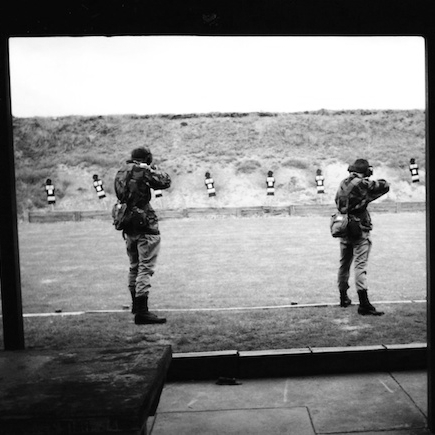
A democracy makes a deal with its 18 year olds with uniforms and guns.
We trust you.
We'll fall asleep in leafy suburbs next door to where you slumber beside your weapons.
We trust you not to turn those weapons on us.
We know History. We can't afford not to give you uniforms and guns.
We know History. We can't afford to wait to see whether our trust in you with guns was misplaced. That would be too late.
Instead -
We demand that you have higher levels of behaviour enforced by extra criminal laws.
We'll let you come onto our streets with your guns as long as we see you marching in controlled, neat, shiny, uniform ranks and snapping to attention when ordered to by superiors who have superiors who have superiors who defer to our elected government who we can vote out and ridicule on talk back radio and on Facebook.
If you behave in any way that hints that our trust in you might be a mistake:
Then we'll punish you immediately and mercilessly and publicly - disproportionately than if you were an unarmed teenager.
It's not your misogyny, pot smoking, petty theft, drunkenness, harassment or racist emails that we want to protect ourselves from.
It's your judgement.
And the guns in your bedroom.
Power.

'The law always limits every power it gives.'
- David Hume
Step 2 of the Five Steps to a Good Decision: Name the Issue.
It's only an Issue if you have the power to make a decision in support of your Widget.
Ask: What power do I have?
Look for it in your contract.
Look for it in your policies.
Look for it in what your boss has said she expects of you.
No power? Then there is no Issue and therefore no decision required of you. Inform someone who does have the power.
Power?
Then ask:
What are the conditions or restrictions on the exercise of that power?
Welcome them. They give focus. Quieten the noise.
If you have a power - you have limits.
Be clear on what they are.
(You'll often find them in your Values.)
Then continue to Step 3.
Freedom.

'No science will give them bread as long as they remain free. In the end, they will lay their freedom at our feet and say to us, "make us your slaves, but feed us."
'So long as man remains free, he strives for nothing so incessantly and so painfully as to find someone to worship."
'I tell Thee that man is tormented by no greater anxiety than to find someone quickly to whom he can hand over that gift of freedom with which the ill-fated creature is born."
- Fydor Dostoevsky, 'The Grand Inquisitor'.
The boss gives us bread in exchange for our days.
The boss is an altar upon which we lay our laments.
The boss relieves us from the anxiety of freedom.
The boss is our alibi.
Burden.

'You're asking me to quash his conviction?'
'Yes Sir.'
'Even though he pleaded guilty?'
'Yes Sir.'
'The Law is an ass, Bernard.'
Air Commodore Smith was a 'one star' general equivalent.
He'd graduated from the RAAF Academy the year I was born.
He was an Engineer. A Fighter Pilot.
He was flying Mirage fighters at twice the speed of sound at 40,000 feet over Malaysia during the Vietnam War when I was still in nappies.
He was a Member of the Most Excellent Order of the British Empire
He was the Air Officer Commanding Western Australia.
He had a wife and grown up children.
He was my boss.
I was in my mid-twenties. Three years out of Law School. Four ranks and a thousand years junior to him in work and military and life experience.
'The Defence Force Discipline Act allows you to seek a higher legal opinion if you're not comfortable with mine, Sir,' I explained to him.
'Not necessary,' he said as he signed his acceptance of my review and recommendation to quash the conviction of the cannabis smoking airman on the basis of an error of law. 'You've explained your reasons both in your written report and verbally to me today and I accept the stupidity of the Law, not you. I'm going to bring this legal loophole to the attention of the other Base Commanders at our conference at Headquarters next week. They need to know about it.'
A month later, a file 'Command Legal Matters' was marked out to me by Wing Commander Oliver, the Air Commodore's Administrative Staff Officer. I opened it and found a copy of a letter that was marked to me 'For Information'.
It was a letter from the Air Officer Commanding Training Command, a two star general equivalent and my boss's boss. It was written to all the Air Force Base Commanders in Training Command - including my boss. It referred to the recent Commanders Conference and the jurisdiction issue I had cited to recommend quashing the conviction. It was admonishing my boss for quashing the conviction based upon my legal advice.
One line stands out in my memory: 'There is no place for High Court decisions in the administration of summary hearings under the Defence Force Discipline Act on Bases. Command Legal have confirmed this. Commanders should therefore seek higher headquarters legal advice in future before quashing convictions based on jurisdictional grounds. '
The Air Commodore never mentioned the letter nor his boss's criticisms of him at his commanders conference to me, let alone my legal superiors' contradictions. I don't even think that he intended the letter to come to me - otherwise he would have spoken to me about it rather than have me find out via a marked out file. He must not have thought it important.
Air Commodore Smith backed me. He backed me over the commanding officer whose guilty verdict he quashed. He backed me in front of his boss. He backed me before his peers. He backed me when he could have gone to my legal superiors for a second opinion. He backed me even though he disagreed with the legal outcome as a matter of common sense. He backed me when my own legal superiors did not. He backed me with the same business-as-usual manner as he would return my salutes if we passed each other or crack his lawyer jokes.
Air Commodore Smith didn't need to hear a Supreme Court Judge affirm my legal reasoning at a Legal Officers conference six months later. He continued to challenge, question, and ultimately back my advice to him for the remainder of my posting as his legal adviser.
His faith in me was a huge burden. It increased my self-doubt because I had to continue to live up to his total reliance on me and I thought I could not. It made me feel more exposed, rather than protected. It made me more careful and diligent in the legal advice that I gave to him. It made me accept other decisions that he made as the Base Commander that I did not necessarily understand or agree with because I trusted him based upon the way that I had seen him go about his decision making. It connected me to him. It made me a better legal officer, lawyer and person. His trust in my judgement and legal ability and officer qualities was hard to live up to.
Which was another gift that Air Commodore Smith gave me.
He just assumed I was up to it.
Backed.

'Decisions made by my Chief of Staff and my Office have my full backing and authority. Anyone who suggests otherwise is wrong.'
When your boss says 'I'll back you,' - and she does - that's arguably one of the greatest gifts.
And a huge burden.
Pass both on.
Say: 'I'll back you,' to your people.
Say: 'I'll back you,' to your customers.
Say: 'I'll back you,' to yourself.
Feel your burden ease.
Feel the anxiety in your chest.
Backing them isn't a sentimental leap of faith into the unknown.
When you back them. When you promise them - or at least yourself - that they act with your authority and that you will stand by their decisions regardless of the outcome and accept all the consequences - you realise you're utterly compelled to:
- Know them
- Clearly define their expectations
- Define their Widget
- Equip them with everything you have - especially information
- Affirm them
- Get out of their way
When I reflect on my good bosses.
My peers.
My parents.
I think that the message - in words and deeds - of 'I'll back you,' taught me the most about work, myself, and life.
'I'll back you,' says: 'I believe in you. Go and become that person I see and believe in.'
[Now think of the converse and understand how damaging and destructive it can be not to have the backing of a boss. It wounds our soul.]
[Now think of a boss who backed you - and write to them and thank them for the faith they showed in you.]
Laying down your life for another isn't as literal as the mournful notes of the Last Post honouring war dead have us believe.
It's putting yourself at risk to back another.
Is this the answer to how we bring Love into our workplaces?
The Greatest Love?
By backing each other?
Punish.

'At an early stage Abbott defined his priorities: securing the site, returning the bodies, an independent inquiry, and punishing the guilty.
Each day his sense of mission is clearer. It is the key to crisis management. Abbott said late yesterday he had but one purpose: "to bring our people home"...'
The unconscious priority of decision makers is often the reverse: finding and punishing the guilty, then finding the information that supports the decision to punish.
Our decision making is influenced by the need to punish more than we realise.
(We don't make decisions - we make 'judgements'.)
Vengeance. Deterrence. Retribution. Justice.
No organisation other than the state can give any of these.
None should behave as if they can.
This subconscious need to punish is also why some won't make a decision.
'Who am I to judge?'
If we're not the decision maker, we project that assumption onto the person who is.
We won't offer information relevant to a decision.
'What if I'm wrong? I don't want to be responsible for what happens to someone else.'
We don't want to lead someone to the hangman's noose.
It's just information.
How do we avoid being distracted by our punishment bias?
Clarity of our Mission. Our Purpose.
They.

'The school was closed after the teachers alerted the Principal to items in other rooms that they thought may have also been asbestos,' Mr David Axworthy, Deputy Director General Department of Education explained to the interviewer.
Interviewer: 'Why was it that teachers initiated this action and not the Education Department?'
Mr Axworthy: 'The teachers are the Education Department.'
Touché.

Wrapping.

A complaint is information wrapped in the complainant's emotion.
The wrapping must be respectfully separated and put aside amidst the eagerness to get to the gift of information inside.
To decide what that information tells you about your Widget.
It's information.
About.
Your Widget.
A Judgment delivered by the Federal Court yesterday affirmed this, namely:
- The organisation gets to decide how to respond to a complaint - not the complainant
- Labelling a complaint as ‘formal’ or ‘informal’ is irrelevant to how its dealt with
It's information.
About.
Your Widget.
As with any gift-once the information has been handed to the organisation, it's the organisation's to use as it sees fit.
One difference between a complaint and the other information that thuds daily onto a decision maker's desk is it has an owner.
That's a good thing. It's healthy for an organisation to deliver a public performance from time to time of its information management and decision-making.
As long as the decision maker remembers:
The complainant may own the complaint.
The organisation owns the outcome.
Partnership.

You want to make a Widget.
I like the Widget.
I can help you to make it.
It can be Ours.
Let's call it Employment.
We'll define the Widget.
We'll agree what each will do by when.
Let's call it a Contract.
I'm not serving you. You're not controlling me. We're equals.
Creating the Widget.
There will be uncertainties during construction. One or both of us may feel anxious. That may be difficult. It will demand effort from each of us to resolve it to the satisfaction of the Widget. It will be hard.
Let's call it Work.
Effort.

'What is important is what has consequences.'
- Reinhard K. Sprenger
There was the senior manager who explained that the problem with his organisation was that no-one would make a decision and they wouldn't because they were afraid of the consequences and yet he said that there were no consequences.
Makes perfect sense.
Good decision-making is hard work.
If the hard work has no consequences then it couldn't have been important.
Why bother?
IAW

In Accordance With.
A familiar term to anyone who has served in the military.
IAW Defence Instruction PERS 34-4, I...
IAW Chief of Defence Force Directive, I...
IAW the directions of my Commander, I...
'I am making this decision as the servant of an inanimate, objective, indifferent, neutral pardon-me-and-no-offence-and-I-couldn't-care-less-I've-never-even-met-you-let-along-formed-an-opinion-about-your-mother source of authority.'
Not iaw my ego.
Not iaw my personal Widget.
Not iaw my biases.
Not iaw my instinct.
Not iaw I got out of the left side of the bed today.
Step 2 of the Five Steps to a Good Decision is to Name the Issue.
One way to do this is to check our decision making authority.
Try drafting an announcement of your decision that begins with:
'In accordance with...'
Answers.

I could tell the knock of a pilot on my office door. The ones who knocked. Most just slipped in and closed the door behind them and sat down and talked.
'I've got a job offer with Qantas,' they would whisper. 'But I've got a ROSO and I want to know how to get out of it. Can I get out of it?'
Military pilots had a Return of Service Obligation. Nine years of Air Force, Navy or Army flying after graduation from Pilot Course. The taxpayers want a return on their million dollar investment in jet fuel and tyres.
'Resign and find out,' was my advice.
The Air Force Act said that an officer could resign at any time and the Governor General had to accept the resignation unless there was a war on or the officer had a ROSO - in which case the Governor-General could choose to say 'No'. Only the Governor-General had that discretion.
'But will they let me out of my ROSO? I've been told that I can't resign if I've got ROSO left.'
'You won't know until you decide to resign.'
Everyone wants the Answer.
The Engineer is asked to answer a bridge. Every passenger in every car, truck and train and every pedestrian on the walkway each day after it is built repeats the question. Each journey brings the Engineer closer to the answer.
The pilot is asked to answer the landing. She finds out along with her passengers as the wheels slam onto the tarmac at the end of the flight.
The lawyer is asked to answer the liability. She learns it along with her client as the judge reads out her verdict at the end of the trial.
Ask a question and get an answer. Yes. No. 27. Liable. So what?
There are no Answers - just Decisions that advance us towards where we want to be.
Only charlatans market Answers.
Theory.

'Whether you think you do or not, you do have a theory of human behaviour. The only choice is in deciding which theory you will use. And the choice is an important one. It will determine how you see people, how you treat them, your assumptions about them - including yourself. It will affect your values, your views about motivation, the quality of your interactions and your leadership.'
- Elliott Jaques
Requisite Organization: A Total System for Effective Managerial Organization
Dr Elliott Jaques was a psychoanalyst by profession. He believed that you don't change organisations by changing people, you change people by changing organisations. Or perhaps you free people to become who they are, by changing organisations.
He had a lot to say about decision making in his book Requisite Organisation. Here is a selection.
'Retrievals and calculations are often confused with decision-making, a confusion which weakens our understanding of true decision-making.'
'All human thinking, and therefore all human work, is a continual and powerful interplay between non-verbal mental processes and the knowledge which we use to direct and focus those processes.'
'The work which you experience as the effort in decision-making is the effort in giving energy and direction to the non-verbal mental processing and bringing or allowing the outcomes into verbalisable awareness, so that they an become part of your knowledge and available for conscious use in problem-solving.'
'Decision-making has to do with human uncertainty:
- It is precisely the uncertainty inherent in human work, the feeling of never being quite sure, that makes you close your eyes and agonise over decisions.
- You do not have all the words, and as you agonise you get hold of raw ideas, clothe them inwards, and dig them from the unverbalised recesses of your mind.
- If you are given tasks of complexity beyond your capability in a role with too long a time-span you become anxious and eventually confused - there is a longer run of uncertainty and more variables than you can cope with.'
'Decision-making and action call for judgement and discretion based upon non-verbal mental work. I term our ability to do this our complexity of mental processing.'
'But never forget, at the actual moment of choice, the choice or decision just gets made, as though on its own, and we become aware of what we have chosen only after we have committed ourselves to some specific particular choice.'
'Skilled knowledge helps to organise and simplify work by enabling a person to carry out parts of a problem-solving activity without having to think about them, thus freeing discretion and judgment which would be otherwise engaged.'
'The important thing is not to confuse the skilled knowledge with the work.
- Skilled knowledge you do not have to think about: work is the part you have to attend to, think about, and make decisions about.
- When you are skilled at touch-typing you no longer have to think about which keys you are seeking - that is automatic: but you do have to think about whatever it is that you are using the typewriter to record.'
'The art of the good society and of the good organisation is to ensure opportunity for the use of their full potential by all of its people.'
'My whole orientation is towards the performance of individuals in carrying out purposeful goal-directed activities.'
'What we all really yearn for is to have work at a level consistent with our current potential and for progression in line with our maturation, and the chance to get the necessary education and training. That is the true democratic dream.'
'What is more, subordinates yearn for someone above them to sit down with them and discuss their careers and opportunities: and this includes not only those with growth in potential ahead of them but also those who know that they have matured to full potential and seek assurance of continued opportunity to work at that level.'
'You have no idea of the positive galvanising effect upon your people of having their intuitive awareness of their own true potential confirmed by understanding managers-once-removed who have been charged with this duty. Indifference is annulled and a flow of creative energy is released.'
'Manifest Organisation: the organisation structure as it is represented on the official organisation chart: at best a very rough approximation to what is actually going on, if you can even make sense of it.
Assumed Organisation: the structure as different people assume it really works; likely to have as many variations as you have people, and produces confusion.
Extant Organisation: the system as it actually functions, as demonstrated by systemic study. It will always be an approximate picture. It requires that you dig in and find who is actually being held acceptable for what, and what authority they are in fact able to exercise in relation to whom and toward what.'
'If you want each and very one of your managers - at all levels and in any and every function - to be able to be held accountable for deciding what outputs each of their immediate subordinates is producing...then you must ensure not only that they have the following minimum authority but also that they have been taught that they have it and have been instructed in how to use it:
- Veto any new appointment
- Decide types of work assignment
- Decide effectiveness appraisal
- Decide removal from role.'
'To ask a manager about specific tasks which she/he assigns to a subordinate comes as an unfamiliar experience for most - and the managers find replying equally strange and awkward until they get used to it.'
'There is a very important point to be noted here, which will save a lot of susbsquent confusion if taken into account.
- Work (and its complexity and difficulty) is not the traversing of known paths.
- The work is to choose pathways or construct new ones, and to adapt them as you encounter unanticipated difficulties in traversing them.
- Obeying known rules and regulations is not work: it does not constitute a problem: deciding how best to obey under particular circumstances may do so, for rules and regulations set boundaries (prescribed limits) within which your choice of pathways is constrained.'