Resolved.

It's rare to hear someone reflect on a conflict in a former workplace and say:
'My life is worse because of it.'
Many people believe that the goal of conflict management is to make everybody happy.
Yet when you ask those people 'What are the chances of that happening?', they shake their heads and say 'It's almost impossible.'
We need to have some reference point as to when a conflict is resolved.
Universal happiness - complainant, respondent, boss, customer, widget - is not a realistic one.
Resolving conflict so that people can get back to the widget has benefits beyond the widget.
It lets them think 'Well, whether I like it or not, it has been resolved and I now need to make choices based upon that.'
It's rare in life to have an umpire who resolves something for us and says 'Here's what's going to happen.'
That's what a good boss does when she resolves a conflict.
We may not like it. We may not agree with it. It may not be what we wanted. Yet it provides a reference point for our decisions about our life and our happiness. We regain control in an environment where we may have felt as though we'd lost it.
What might seem like a loss in the world of my cubicle, can be a win for personal growth, creativity, and realisations about where I want to be in the world of my life.
Trigger.

The majority of people votes for politicians who elect a leader who consults with her Cabinet and makes a decision that she passes on to her General who promulgates orders that are issued down the chain of command to a 19 year old rifleman with the optical scope of his weapon pressed against the pimple on his cheek.
Along with hundreds of other soldiers sailors and airmen issuing orders, pushing buttons, pressing levers and delivering violence upon other humans on seas, in skies, from air conditioned cubicles and lying on other bits of dirt, the teenage Private pulls a trigger and kills a stranger and thus produces his Widget.
Trust is like the lubricant between the working parts of the teenage infantryman's rifle that respond to his index finger pressure and discharge the round at supersonic speeds towards its living target.
Without trust, the mechanism that delivers a decision from the elected leader to the finger of an infantryman will friction and fail.
The military trains Trust.
Navies, Armies and Air Forces have learned and refined over hundreds of years how to recruit, train, exercise, promote, educate, discipline and remember people who demand and honour high levels of trust.
The military's widget - applying maximum violence permitted by law upon the enemy - is designed a long way from where it is delivered by mostly young women and men. They do so while knowing that their own deaths or maiming are part of their adversary's widget.
Trust is a force multiplier.
Police forces demand similar levels of trust. A probationary constable can deprive a person of their liberty and moves among their community with a gun.
Meanwhile, in the open plan battlefield and amidst the chaos and din of values statements, codes of conduct, team building exercises, most managers distrust their workers.
After all, if they were trustworthy, why would they need managing?
Ding-a-Ling.
'It has so much to do with hiring. You see so many big companies that don't understand why they aren't the big disruptive company anymore. Well, that's because you hired these guys that you could work with, and who have the same disabilities as you, and they hired more people that they could boss around with the same disabilities. And you wonder why you've got a bunch of ding-a-lings running around trying to boss everyone around. Well that's who you hired. That's who the company is.'
Recruit hard, manage easy - works both ways.
We don't understand what happened to our enthusiasm. We fall asleep replaying scenes from our day and see ourselves behaving like a ding-a-ling.
Well, that's because we applied for and accepted a job where we're bossed around by a ding-a-ling, whose boss is a ding-a-ling (must be to keep paying a ding-a-ling).
That's who the organisation is.
That's who we are.
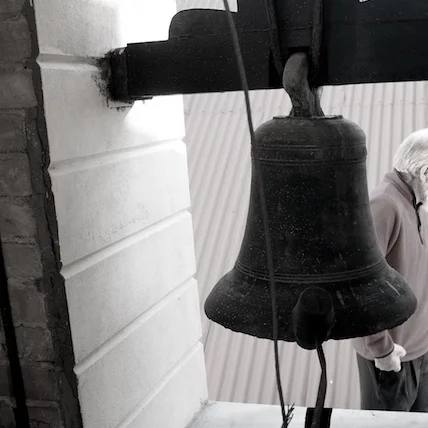
Ring it!
Ca-ching! Pay day!
Participants in the arduous training to qualify as United States Navy SEALS signal their decision to quit by ringing a brass bell.
Ding-a-ling-a-ling-a-ling.
'Hey everybody! I'm humiliated and embarrassed to announce I've decided that I don't need to spend the best years of my life being cold, tired, wet, endangered, and in physical and mental pain as I follow orders so that I can kill strangers in defence of my country!'
Ring it!
Whatever the judgement of others - at least have the courage to declare we're playing by someone else's rules. Or not.
Grab that bell and ring it.
I'm here because I need the money.
I'm here because I'm afraid of the alternative.
I'm here because I don't think I'm good enough to be accepted anywhere else.
Liberation into anxious freedom begins with seeing, pointing and naming. Out loud.
Especially the hard and shameful stuff.
Perhaps start with 'Here is the cage I've locked myself into and here is the key that I won't use because I know my cage and I'm afraid of what's outside it.'
Ring it!
Murmuring.

St Benedict stated in his Rule for monks that there is no greater evil in a community than 'murmuring'. That sixth century behaviour translates as gossiping or underhanded and hidden criticism of someone in an organisation - usually in authority.
The character of Don Draper has very little in common with the monastic life. However, he quickly and effectively dealt with murmuring in Season 7 of Mad Men.
He receives a letter purporting to terminate his partnership in the firm. After a moment of reflection (Step 1 - Step Back), he summonses all the decision makers who may have conspired against him out of their offices and into the open plan - where they could each see and be seen by Don, each other, and the other non-decision making staff.
Don: 'Hey! Get out here!' I just got a breach letter with your name on the bottom.'
Roger: 'What?'
Don: 'Joan! Get out here! Joan! Could you get Cooper out here?
Joan: 'What's going on?'
Don: 'Find Pete. No-one knows about this?'
Joan: 'I saw it.'
Don: 'Then why did you say 'What's going on?''
Cooper: 'I want you to calm down. I just called Jim, we're going to get the bottom of this.'
Pete: 'Is there a meeting?'
Don: 'Have you seen this?'
Pete: 'This is outrageous! You know we're going to be at Burger Chef on Monday!'
Roger: 'I vote against this. Right now.'
Jim: 'It's not subject to a vote. The contract is very clear.'
Don: 'You want to play parliamentary procedure? Let's play. Everyone who wants to get rid of me - raise your hand.'
Jim: 'Fine. I have Ted's proxy.'
Cooper: 'You had no right to put my name on that!'
Don: 'Anyone else?... All opposed?...Motion denied!'
Pete: 'That's a very sensitive piece of horse flesh. He shouldn't be rattled!'
- Mad Men Season 7 'Waterloo'.
Good decision making draws the decision maker out of his office into a neutral space of inquiry and invites those who may be affected by it to contribute in full view of each other.
Somewhere.

"Would you tell me, please, which way I ought to go from here?"
"That depends a good deal on where you want to get to," said the Cat.
"I don’t much care where--" said Alice.
"Then it doesn’t matter which way you go," said the Cat.
"--so long as I get SOMEWHERE," Alice added as an explanation.
"Oh, you’re sure to do that," said the Cat, "if you only walk long enough."
- Lewis Carroll - 'Alice in Wonderland'
A good decision is one that advances me towards where I want to be.
Do I know where I want to be:
- In one second (while you're yelling at me)?
- In ten minutes (after you've stormed out)?
- In six hours (after I've read your complaint)?
- Next week (after my boss has read your complaint)?
- In six months (when my performance review is due)?
- In a year (when my daughter asks 'What do you do at work, Daddy?')
- In thirty years (when I'm dying)?
- In 200 years (when my great-great-great-great gand-daughter is researching the Family Tree)?
My boss can answer the first five.
(A good boss cares about six, seven and eight because she cares about one to five.)
Emotion may excuse the answers to one and eight.
Good decision making will answer the rest.

Loud.

Following the Five Steps to a Good Decision is thinking out loud.
It's teaching.
Leaving a trail that others may choose to follow - or not.
Communication.

We grow up to the sound of cheers and boos.
Parents affirm our good behaviour and correct the bad.
Teachers grade our work.
Coaches urge us on and post our scores.
Peers select and reject us.
Employers do the same.
Right up until we give payroll our bank details and pull our chair into our desk and log on.
Then the stands fall silent.
'There's a lack of communication here,' we say.
'I don't get any feedback.'
'Not so much as a 'Thank You'.'
(As we transfer money from our savings account to our mortgage account.)
It's time to grow up.
When the Boss says nothing she's saying:
'I trust you to do the work.'
On pay day she's saying:
'Thank you.'

Trust.

'People do not have to love each other, or even like each other, to work together effectively. But they do have to trust each other in order to do so. Trust between people is the basic social glue: suspicion and mistrust are the prime enemies of reasonable human relationships.'
- Dr Elliott Jacques, 'Requisite Organization'.
A witness in the Royal Commission into Institutional Responses to Child Sexual Abuse was asked why he didn't act on a report by one of his staff.
'Because I didn't think that I had enough information to act upon,' was the essence of his explanation.
'If you had witnessed the behaviour yourself, would you have acted upon it?'
'Yes,' he replied.
Here was a rare glimpse into the dirty little secret of almost every organisation and the root cause of their dysfunction.
Bosses won't delegate decision making power because no-one else has the skill to see and interpret information and act upon it as effectively as they can. They're the Boss, after all.
Workers who have delegated decision making power but don't use it because they assume their boss must have a superior understanding of the same information. They're the Boss, after all.
If we fail to act on information given to us by another in the same way that we would if we had first hand knowledge of that information, we declare:
'I don't trust you.'
In which case cancel the off-site team building exercises, Myers-Briggs Tests, Christmas party, external consultant reviews, coaching, values statements, and staff surveys.
And spend the savings on the glue in Payroll to retain the untrusted people who remain to service their mortgages, and to hire the extra managers needed to supervise them.
Knowing.

Peggy: Did you park your white horse outside? Spare me the suspense and tell me what your Save the Day Plan is.
Don: I don't have anything yet. The idea I had wasn't great.
Peggy: It wasn't great. It was terrible. Now I want to hear the real one. Or are you just going to pull it out during the presentation?
Don: This idea is good. I think we can get the client to buy it.
Peggy: No you don't. Or you wouldn't have questioned it.
Don: I'm going to do whatever you say.
Peggy: So you're going to pitch the hell out of my shitty idea and I'm going to fail?
Don: Peggy, I'm here to help you do whatever you want to do.
Peggy: Well how am I supposed to know?
Don: That's a tough one.
Peggy: You love this.
Don: Not really. I want you to feel good about what you're doing but you'll never know. That's just the job.
Peggy: What's the job?
Don: Living in the "Not knowing".
Peggy: You know I wouldn't have argued if it was me. I would have just given you a hundred ideas and never questioned why. You really want to help me? Show me how you think. Do it out loud.
Don: You can't tell people what they want. It has to be what you want.
Peggy: Well I want to go to the movies.
Don: Whenever I'm really unsure of an idea, first I abuse the people whose help I need. And then I take a nap.
Peggy: Done.
Don: Then I start at the beginning again. And see if I end up in the same place.
- Mad Men - Series 7 'The Strategy'.
Subversion.

'A leader engages in this task of constructive subversion. What they subvert is unthinking custom and practice. A leader will not accept that things are merely done because everybody does it, because that's just the way that we do things around here.
But they're not seeking to impose some kind of idiosyncratic view of their own on the organisation. They're not trying to bring it down. It's constructive because the job of leadership is to help the organisation become more like the thing it says it wants to be.
But to do this requires extraordinary moral courage. It's really, really hard.
Can you imagine what your colleagues are going to do? Some might say it's fantastic. A lot are going to say 'Sorry, just get out of the way and let us get on with it. We know what we're doing.' And there will be your peer group who will be pretty annoyed with some of you who do it because if you start doing it then they might have to start doing it and that's going to be a burden.
Resource constrained. Time constrained. 'We're just trying to cope and you want us to do this as well?'
And there will be superiors who will get pretty annoyed from time to time that you have asked the difficult question that if had just been left unasked it would have made life more bearable.
Yet that is not leadership.
If you're going to lead. If you volunteer for the task. This is the sort of thing in which you're going to have to engage.'
- Dr Simon Longstaff, Director of the St James Ethics Centre
Judgement

The New York Times published an interview with Ron Kaplan, the CEO of Trex, a manufacturer of outdoor decks on 'Making Judgements Instead of Decisions'.
It's an opinion on the difference between decision making and judgement.
'To this day, I find I’m most effective as a leader by facilitating other people talking.'
'When people speak, you measure the variance between what they tell you is going to happen and what actually happens. The smaller the variance, the greater the credibility.'
'Decision-making usually is the dissection of facts to come to a conclusion. Coming to a judgment really has to do with the issues of luck, character and probability.'
Tolerance.

'What we don't realise is how much of our feelings, our actions, our beliefs are coming from our unconscious mind and I think that when we raise our consciousness about our unconscious, you're knowing yourself better. And to know yourself better I think is a good thing. You understand how you're going to react and you understand why you did things and you just have more understanding for yourself. So it not only helps you make better decisions economically, but it helps you make better decisions spiritually because you have in a way more tolerance for yourself as well as more understanding.'
- Leonard Mlodinow, Physicist.
Good decision making is a deliberate process of inquiry that advances us towards where we want to be.
I pay attention to my thinking.
I see the world as it is and not as I presumed it to be.
I learn about you.
I learn about me.
Five.

The fifth of the Five Steps to a Good Decision is to Offer a Hearing.
Step 1 is to Step Back.
Step 2 is to Name the Issue.
Step 3 is to Assess the Information.
Step 4 is to Check for Bias.
If you believe that your decision is likely to adversely affect any person, you should allow that person to be heard.
A 'hearing' is simply:
- Informing the person of the information that you have about them.
- Informing them that it may require you to make a decision that may be adverse to their interests or expectations.
- Inviting them to respond to the information and explain to you why you should not make an adverse finding.
A 'hearing' may be a simple as a short conversation, an email or letter.
If the person doesn't accept your offer, you simply make the decision based upon the information that you have.
The ‘Show Cause’ is the best example of the Hearing step in action. It says:
‘I’m thinking of doing X as a result of Y facts and Z policy. I’m inviting you to give me reasons why I should not do X by the close of business on Date. I will consider your reasons before making my decision.'
There are five benefits of the Hearing Step:
- It allows the person with the most at stake to put forward information that can ensure that you are aware of the most personally damaging outcomes of your decision, and assess them accordingly.
- It allows the person to feel involved in their own fate and that you value them enough to engage with them.
- It has echoes of the ‘listening’ in Step 1.
- It is another opportunity for you to Step Back.
- It is one of the most important elements of Natural Justice.
If the person responds, genuinely consider and reflect upon the information that they have given you.
Remain focussed on the relevance of the information to your Widget.
They may tell you about their illness, their lost cat, their 37 years of faithful service, their passion for their job...
Don’t engage with any of these topics if they have nothing to do with your Widget.
Don’t seek to rebut or refute or correct in your response. Simply say:
‘Thank you for taking the time to write those 73 pages in response to my invitation for you to give me reasons why I should not move your desk. I have given all of your submissions my consideration, and after taking them into account, together with Policy X and Report Y, I have decided to move you to the position near the window.’
And you might add: ‘I am sorry to hear about your cat and I can understand how its absence has proved stressful for you. I invite you to take advantage of our Employee Assistance Programme and will approve any reasonable leave that you may require to do so.’
The five steps allow someone to tell us their story and for us to listen.
Our brains love stories.
Mess.

'[The BBC gave us] total freedom. They gave us the freedom to mess up which is the best freedom you can have.
For our first series we made our own mistakes. We made lots of mistakes and we realised the control you had to have to get better - the things we needed to change and appreciate...and we were allowed a second series.'
A good boss anchors the straining tension of paying her workers to build and break and build her Widget.
It takes intelligence, confidence, wisdom, patience, resilience, judgement, and humility to be that kind of boss.
Good bosses are rare.
Workers who are grown up enough to choose the anxiety that comes with the freedom of making their own mistakes - and to change and get better - and thus be worthy of such bosses - are also rare.
Most settle into the comfort and security of the tepid disgruntlement of being told what to do in return for the salary that funds their refuge in their Weekend Widget.
The emphasis on leadership and management in workplaces reinforces a message that Someone Else is responsible.
Someone Else is controlling us and therefore our mistakes.
The They will tell us when and how to get better.
The They will Manage and even Drive Change.
We are free to choose the boss that we deserve.
If.

If I write a good job description for you.
If I write a good job ad for you.
If I write good questions for your job interview and write down the ones you ask back.
If I write to your last boss and ask her if you make good Widgets.
If I write a good employment contract for you.
If I write good policies for you.
If I teach you a good job induction.
If I teach you about my Widget.
If I teach you how your Widget fits into my Widget.
If I teach you with feedback and a pay cheque.
If I get out of your way.
If I Do all of this for everyone who you rely on to help you to Do your job.
If - after you Do it - I say:
Thank you.
If I keep Doing for you all I said that I would Do.
I'd have done my job.
And you'll go on Doing yours.
You don't need to be managed or led.
You just need to be left to Do.
We don't need more leaders or managers.
We need more Writers and Teachers.
We need more Doers.
Need.

We don't need more leaders.
(Too many people leading and an organisation will break.)
One Leader is enough.
We don't need more managers.
(People don't like being managed.)
We need people who follow a deliberate process of inquiry that advances them towards where the Leader wants them to be.
We need Good Decision Makers.
Four.

The fourth of the Five Steps to a Good Decision is to Check for Bias.
A good decision is one that advances us towards where we want to be.
Bias can distract us from our Widget in two ways:
- From brains wired to drown out rational thought by screaming 'RUN!' or 'KILL IT!' in response to new information.
- From egos that put our Weekend Widget ahead of our boss's Widget.
The first Three Steps to a Good Decision often quell the screaming in its more sophisticated 21st century workplace manifestations.
The second is mostly tackled in long and overly complicated policies around 'conflicts of interest.'
The easiest way to detect whether we have this kind of bias is to ask ourselves:
‘Am I able to apply my mind to the information and assess its merits and exercise my discretion unhindered by any personal investment in its outcome?’
If you do feel personally invested, you need to tell your boss and let her decide whether you should refer the decision to someone else.
After all, she's paying you to build her Widget.
![[Inspired by Hugh McCleod's 'Value Curve'.]](https://images.squarespace-cdn.com/content/v1/501409fee4b00a22f5c6f17b/1398091255969-JSVXG701FCJL0M8YJAZC/Good+Decision+Making.jpg)