Visible.

A Leader makes the work visible.
In knowledge work, decisions build upon other decisions as they move along the assembly line to emerge as the organisation's Widget.
A Leader makes decisions that are visible in process and outcome to others who need to follow.
The word educate comes from educare which means to ‘draw out’.
Leaders draw out followers by making decisions that in turn open up space for them to make their own decisions that they know will be supported by the Leader.
We will follow someone whose decision making processes are transparent and predictable. We gain the confidence to make our own decisions that build upon and enable the decisions of our Leader.
Leaders are teachers and teachers are leaders because through their decisions they draw others into engagement with the world.
Many ‘leaders’ do the opposite. They make decisions in isolation and using processes and reasons only known to them. They sit in meetings where they have exclusive access to information that they use to make decisions. They then expect their followers to act on their decisions based on positional power alone.
A Leader whose decisions are based on policies or other visible processes and who is not afraid or too busy to explain her reasoning, particularly in response to criticism or complaint – or...her own mistakes...is more likely to draw out her followers from their bunkers of fear or suspicion.
'The decision about what to do next is even more important than the labor spent executing it. A modern productive worker is someone who does a great job in figuring out what to do next.'
Seth Godin
Primary.

'To defend Australia and her interests, Sir?' the Air Force First Year Defence Force Academy cadet said in answer to my question.
'Yes, but no, ' I said nodding towards the Navy Midshipman with her hand up.
'To protect Australia's sea lanes, Sir?' she said.
'The main aim. What's the main aim of the Australian Defence Force,' I repeated.
Only two hands remained in the air. I picked them off.
'No - not to assist in natural disasters. We do that, sure, but that's not why we exist. And no, not to assist in Peacekeeping. Again, we do it, but it's not the primary role of the military.'
I scanned the young faces staring back at me, barely clean of their mums' lipstick on their cheeks as they were farewelled into the arms of the Navy, Army and Air Force as Midshipmen and Officer Cadets.
'Those answers got you through the recruiting process, but none of them defines the job that you've signed up to for the next nine years. So let me tell you:
'To apply the maximum amount of violence permitted by law upon the enemy.'
Some faces froze. Others began to grin.
'That's the aim of the Australian Defence Force,' I said, looking at each of their young faces in turn. 'To apply the maximum amount of violence permitted by law upon the enemy.' The job of an Officer is to ensure that those under your command use their weapons violently and lawfully. Which is why it's been said that, as Officers, you are a 'Manager of Violence'. Other people here will teach you about the management and the violence. I'm here to teach you about Military Law.'
It's obvious why the military fudges its advertised Widget. Organisations camouflage their Widget for many reasons. Most are to do with marketing and recruiting.
This is where most of the difficulty applying Widget Thinking begins. If we don't advertise, recruit, contract, orientate, train, promote, manage, terminate - make decisions - using the Widget as our reference point, then we're navigating with a swinging compass without a True North.
The latest scandal to hit the Australian Defence Force has had the talkback lines buzzing. 'We don't want our daughter joining the Army after we heard about this behaviour,' one father called in to say. 'We don't think it's safe for her.'
Made.

The Widget doesn't care.
It just wants to be made.
It doesn't care if it's by a man or a woman. Old or young. Rich or poor. Buddhist or Rastafarian. Mother or Transgender. Morning person or late arrival. Part time or full. Masters degree or apprentice. Black or white. Make it.
Did the Widget get made? Boom.
Widget Thinking creates clear job ads and precise duty statements with good salaries that attract skilled workers with realistic expectations to cooperate with co-workers in safe workplaces to make Widgets.
Widget Thinking is the answer to all the isms.
A workplace where there is harassment, bullying, hazards, discrimination, conflicts of interest, illegality or unethical behaviour produces Widgets made by distracted, fearful, unqualified, wasteful workers.
The Widget will roll off the literal or metaphorical assembly line as the unsentimental, disinterested, objective witness to any isms.
Because the Widget doesn't care.
Neurons.

'I'm sorry that I didn't seek your advice today,' the Air Commander said over drinks in the Mess, 'But I didn't have a neuron spare.'
I'd watched from two seats along as he'd coordinated fighter aircraft launches into the skies over Northern Australia and beyond to defend it against waves of attack by the Kamarian Air Force. He was making a decision about every two minutes for eight hours.
What I wanted do say was 'You need to practise having a neuron spare, Sir. Better for you to practise and learn when the air battles are staged.' But I didn't. I was only a Flight Lieutenant Lawyer and he was a Group Captain Fighter Pilot and I wanted to make it to Squadron Leader.
'We didn't have the resources to stop and attend to the enemy wounded,' the Army Lieutenant Colonel Infantry Officer had explained to the International Committee of the Red Cross representative who reported this breach of the Law of War to me in Exercise HQ. 'They need to train as they would fight,' I wrote in my post-Exercise Report. 'They must learn what resources that they need to fight lawfully.' I scraped promotion to Squadron Leader.
'We don't have time to comply with the various policies in this organisation,' the senior executive said to me as his peers in the audience nodded with folded arms. 'We're too busy doing our jobs.' More nodding and the beginnings of applause. 'You need to practise having a neuron spare,' I quoted myself. 'Those policies are laws and doing your job means doing it lawfully.' I glanced across at the CEO who was texting on his phone.
Good decision making is a skill. Like any skill it needs to be practised until it becomes routine. We need to build the neural pathways by applying the Five Steps until doing so is unconscious. It's called being Professional.
The Air Commander wondered out loud how he could resolve his Rules of Engagement with the radar blips playing out on the huge screen covering the wall in front of us. It was the last wave of the week. 'Air-to-air missiles are not classed as 'aircraft' under International Law, Sir,' I said, loudly beginning my unsolicited advice.
He bought me a drink in the Mess that night. 'Let's kill a few of those neurons you made me exercise today,' he said.
Happy.

'I want everyone in my team to be happy.'
He made this declaration half way through a Good Decision Making Workshop with a group of senior leaders.
He was experienced, but new to my client organisation. He'd arrived half an hour after the Workshop had started.
It's wrong to argue with a manager who wants happy workers. So I did.
'What about if two of your staff members are in conflict?' I asked. 'How would you know when it was resolved?'
'When they were both happy,' he said.
I was distracted by a unicorn passing beneath a rainbow made up of a chorus of coloured butterflies outside the window. So I don't know whether the other executives were rolling their eyes.
'What do you think is the likelihood of resolving it then?' I asked.
He made a speech about how he could never work in any organisation that did not put the happiness of its employees above everything else. It was a very good speech. It gave me time to think up a response that would help him to realise the folly of his ways without embarrassing him in front of his peers. I was all loaded and ready with my rebuttal when he concluded with:
'So I'm sorry - but my Widget is the happiness of my staff.'
I screwed up my mental notes.
'You're right,' I said, triggering the other executives' heads to swivel from him towards me.
'As the line manager of your staff - it's your Widget and it's not for me or anyone else bar one person to tell you otherwise. So if your Widget is universal staff happiness - then so it is.'
He looked disappointed that I'd laid down arms.
'And if your line manager is satisfied with that Widget, then great,' I continued. 'If she affirms you producing happy staff and that serves her Widget - excellent.'
I was being sincere.
I hope that he was as well.
I hope that he had a line manager who did support his Widget and that his line manager's manager supported her...and so on.
I hope that his staff is happy.
Beard.

There's an old man with a long white beard and a big book who sits at a large desk in a larger office at the head of every organisation.
Even Liz concedes that it's a man and that he has a long white beard.
That old man is very wise and has all the answers.
('The Onion' ran an article along similar lines about a team of people in a room looking after the entire United States.)
But he's kept in the dark by incompetent people in the management hierarchy below him and so bad things happen to people without his knowledge.
If only we could get past our line manager, her line manager, and everyone in between us and the old man with the long white beard.
If only we knew his direct number and could bypass the help desk, customer service or call centre operator.
If only we could appeal to him the decision that we didn't like.
If only we could tell him our side of the story.
He would listen. Nod. Stroke his long white beard.
He would open up his big book and flick a few pages. Run his finger down the wise words written in it.
He would look up, adjust his glasses, smile at us from behind his long white beard and say:
'You're right. Sorry. I'll fix it for you.'
He would make things right.
He would make us happy again.
I worked for an organisation whose policies allowed a decision to be appealed up to six times - beyond the Chief Executive Officer and to a government minister.
One appeal step was a review of the decision by a committee of experts and the complainant's peers.
'Nothing ever gets resolved,' complainants complained.
'Nothing ever gets resolved,' managers complained.
Leaders nurture good decision making by supporting decisions made at the lowest appropriate level and at the earliest appropriate time.
Because there is no old man with a long white beard.
Beyond.

Listening is Stepping Back.
Listening is the beginning of Leading - Create the Space.
Listen beyond your answer and towards theirs.
'You make other people smart by how you listen to them.'
- Steven Tomlinson
Consequences.

The Australian Electoral Commission gave another example of Good Decision Making today.
Ed Killesteyn the AEC Commissioner was interviewed on Radio National on the decision by the AEC to declare the Senate result in Western Australia despite the disappearance of 1375 votes.
He began by acknowledging the 'gravity' of the situation and apologising to the electors.
He said that he was left with 'a nagging and almost irreconcilable doubt' about the result of the WA Senate election.
The journalist then asked him if this was the case, 'Why on earth is the AEC going to declare the Senate result in WA this afternoon?'
'I have no choice,' Mr Killesteyn replied. 'I am obligated to declare the result. Legally I have no other choice.'
'So you need to do this so that it can be referred to the courts?' the journalist asked.
'That's correct. The 40 day petition period to the courts is only enlivened once the last of all the writs has been returned. '
The Commissioner then summarised to the Australian public, via the journalist, everything that he had done to find the missing votes.
The AEC had already begun an inquiry into the missing votes and was reviewing its procedures.
Mr Killesteyn understands that he is a servant of the Law, which says that he must declare the election. Despite some withering criticism, he recognises that he must make this decision to allow the consequences to begin flowing from it, whatever they may be.
He steps back from his own doubt and uncertainty and does his job. He produces his Widget so that others may produce theirs.
Like most good leaders, Mr Killesteyn is not in the heroic model. He is a career public servant who appears to have discharged his duties without fanfare or fuss.
In a 2009 speech he listed the four principles under which the AEC operated in order to build public confidence in its impartiality, one of which was 'decision-making in accordance with objective application of the law'.
He quoted from a speech given by the Indian Chief Election Commissioner, who said that the Indian organisation was able to retain the confidence of the electors because it was 'a listening Commission'.
Listening.
The Indian Commissioner concluded by saying:
'Being human, we can be wrong sometimes, but our intention should never be impure.'
Mr Killesteyn's words and tone of speech showed that he understood and accepted that his organisation had failed in fulfilling its public duty to deliver on nothing short of the democratic process of a Federal Election.
Yet his voice during the interview was calm, measured, steady and without the edge that one expects from someone under so much criticism. Possibly because he was liberated by the knowledge that while he had failed in his Widget, his decision making was flawless.
His response today was even more remarkable given that it was he who decided to overrule the WA Electoral Commissioner's original decision and to allow the re-count that has ultimately revealed his organisation's errors and undermined public confidence in it, and in him.
Leaders are Brave.

Breathing.

Step 1 of the Good Decision Making process is to Step Back.
Don't mistake decisiveness for good decision making.
Don't mistake power for Leadership.
Don't mistake reaction for action.
Step Back.
Keep Breathing.
Listen.

Listen.
Keep listening.
Listen until your ears bleed.
Listen until the other person falls silent.
Then keep listening.
But they're not speaking.?
Doesn't matter. Keep listening.
They're talking again.
Listen.
They've stop talking.
Keep listening?
Yes.
They're still not talking.
Keep listening.
Neither of us is talking now.
It's been quiet for a while.
Okay it's feeling a bit awkward.
Listen until your ears bleed.
Sure - but there hasn't been anything to listen to for at least half a minute now.
Is it feeling awkward?
Yes.
Keep listening.
Okay this extended silence is starting to feel a little creepy.
You can talk now.
Distance.

Step One of Good Decision Making: Step Back.
Viktor Frankl wrote:
'Between stimulus and response there is a space. In that space is our power to choose our response. In our response lies our growth and our freedom. '
Stimulus: information. A complaint. Criticism. Bad news. New and unexpected data. A problem.
Instinctive reaction. Surprise. Shock. Anger. Defensiveness. Denial. React. Respond. Return fire. Fight.
Impotence.
Step Back.
Lean back in your chair. Stare at the ceiling. Get up and walk. Down the corridor. To the kitchen for a cup of coffee. To a sympathetic colleague's office. Or home.
Have a lemonade or three. Vent to your spouse or pet. Take the cat for a walk. Go for a run. Smash a golf ball. Have another lemonade. Wallow. Feel sorry for yourself. Search the job ads. Watch a movie. Reclaim your freedom.
Be human. Not boss, manager, leader, decision-maker, company woman, parent, mother, father, son, daughter, prodigy. Be worried, annoyed, frustrated, sad, impatient, unreasonable. Wallow. Be selfish.
Allow yourself to be yourself so you can choose to become yourself.
Create the space.
Expand it.
Step up and begin doing what your boss is paying you to do and what you promised her that you'd do. (That's called 'Integrity.')
'I'll have an answer to you by next Friday.' (Aim to have it to them by Wednesday. Under-promise and over-deliver.)
You feel your power returning.
The psychologist Yaacov Trope argues that:
'Psychological distance may be one of the single most important steps you can take to improve thinking and decision-making. It can come in many forms: temporal, or distance in time (both future and past); spatial, or distance in space (how physically close or far you are from something); social, or distance between people (how someone else sees it); and hypothetical, or distance from reality (how things might have happened).
But whatever the form, all of these distances have something in common: they all require you to transcend the immediate moment in your mind. They all require you to take a step back.'
Begin the rest of the Good Decision Making Process unencumbered by the emotions that strangle your ability to analyse and assess data openly and logically and on its merits. Earn your salary. Build your Widget. Become who you are.
'You can't change what's already happened but you can change what happens next.'
- Peter Baines, Disaster Management Specialist.
Yourself.
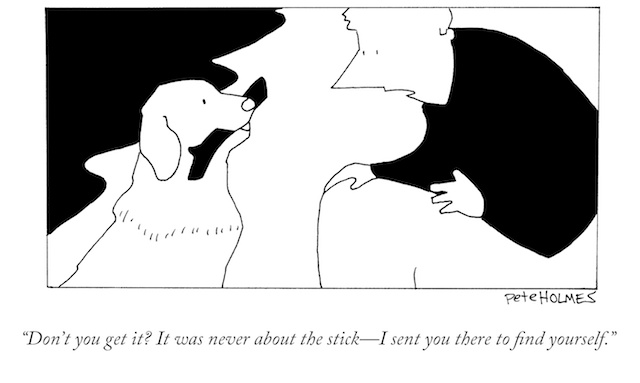
Our Widget is a destination that draws us out of ourselves using the map and compass of Good Decision Making to become who we are.
It's all about the Widget.
It's never about the Widget.
Position.

'What do you think is the main problem with this organisation?'
For three months Liz and I had been trying to diagnose the ailing culture of our new client so that we could fix it. So we asked to meet with one of its top executives.
'People won't make decisions,' he said without pausing to ponder our question.
'Why do you think that they won't?' Liz asked.
'Because they're afraid of the consequences.' His quick responses affirmed that we were asking the right questions and that he had thought about them a lot.
'What are the consequences?' Liz asked.
'There are none,' he said.
Liz and I left the meeting more confused than when we walked in.
It took me another three months to understand the logic of his answer.
Decisions are like a submarine's sonar pings.
A submarine sends out pulses of sound waves that reflect off objects on the surface and beneath the water around it and return to the submarine. The time that it takes to travel back allows the submarine to know its geographic location and depth in the water and the lay of the underwater land above, below, either side and ahead of it. The submarine can adjust its course accordingly.
Each time that we make a decision we send out information that will return new data back to us that will inform us about our world. Like sonar pings. We incorporate that updated information and adjust our understanding of where we are in our job and life accordingly.
In short - we learn.
Each of our decisions also announces something about our identity, views, course and objective. The same act that informs us about our position also declares ourselves to others and therefore exposes us to the risk of criticism, ridicule, error and judgement.
(Another analogy. Certain military aircraft use radar that is so advanced it can tell them the model, not just the location, of another aircraft that is out of sight of the naked eye. But that same radar is what the pilot uses to direct a missile. So while 'painting' another aircraft with the radar can tell the pilot an enormous amount about its identity, it will be detected by the other aircraft's electronics and could provoke the other pilot into fearing that he's about to be fired upon and thus to fire first.)
Our decisions are often what Joseph R. Badaracco called 'Defining Moments' that reveal, test and shape us.
If a submarine pings and doesn't get a response, it is blind. It doesn't know whether it's about to collide with a reef. It will stop, or at least slow down.
If a person makes a decision and there are no consequences - no affirmation, no acknowledgement, no criticism, no echo back - then they are blind. They will either slow down or stop making decisions. They will become passive consumers of second hand information via other people's decisions/pings.
People and organisations need to have good decision making processes that provide us with reliable information about where we are in relation to our professional and personal Widgets.
We also need Leaders who will affirm.
Stories.

Most people's work is disconnected from their Widget.
They go to their office, occupy themselves for eight hours, go home.
They know that they've done a good job because nobody told them that they didn't and they're still getting emails on the All Staff mail list.
Most importantly their boss puts money in their bank each fortnight for them to forward most of it into their mortgage.
Sure, they make things. Emails, reports, meeting agendas, minutes.
They go to quarterly staff meetings and listen to a boss tell them about how the Widget is going with PowerPoint slides in support.
Once a year they sit down with their boss who tells them how they've performed and what courses they need to do because We're A Learning Organisation.
So they go to the professional development seminars with relief at the novelty of being away from their desk and eat mints with the other seven perky strangers on their table as an expert projects PowerPoint slides with dot points about innovation with anecdotes about Fortune 500 companies and other stories to inspire them to be better.
We love stories. They connect us to something bigger.
Good decision making is story telling.
It has a heroic arc that gives us meaning.
It's heroic because it's our conscious act to embark on the journey and accept its possible consequences and take responsibility for them.
It's superior to what most call decision making which is actually an instinctive sneeze-like response to a stimulus.
Our journey begins with the ascent of a hill where we sit at the top and take in the view of the Widget.
Wow. We never realised how close our desk was to it.
Good decision making is a journey that takes us out and back again to our desk and it won't look the same afterwards.
That's what a Learning Organisation is.
'We shall not cease from exploration
And the end of all our exploring
Will be to arrive where we started
And know the place for the first time.'
- T.S. Eliot 'Little Gidding'.
Assembly.

The Atlantic Magazine had a recent article about how some companies in the United States are bringing their factories back home.
While increasing wages in developing countries and higher transport costs from the factory to market are part of the reason, most are found in Widget Thinking.
The time from when a product came into fashion and then fell out had shortened from seven years to two. It meant companies had to shorten the feedback loop between factory floor and design table.
General Electric is one company reversing the overseas outsourcing trend. It originally had designers in the United States and manufacturers in China. It decided to bring the workers who built washing machines into the same building as the engineers and designers.
Workers on the factory floor identifying any improvements or issues could immediately inform the engineers who could consult with the designers who could modify the Widget. One example was when workers recommended a design change that cut the hours needed to assemble a washing machine from 10 hours to 2.
This 'inherent understanding' (unconscious competence?) of the product had been lost with the outsourcing to cheaper labour in China. GE got it back by closing the gap between assembly line and designer.
Co-located assembly and design also allowed companies to adopt the ‘Lean’ manufacturing techniques popularised by Toyota. Everyone has a say in critiquing and improving the way work gets done, with a focus on eliminating waste. It requires an open, collegial and relentlessly self-critical mind-set among workers and bosses alike –a culture that is hard to create and sustain.
It requires a Leader.
Each worker adds their widget to the Widget moving along the assembly line. It's the job of the manager to make sure that the assembly line is itself assembled so that the work is as easy and efficient as possible. The best way for the manager to achieve this is through an open, collegial and relentlessly self-critical approach.
In the GE example, the dishwasher team created its own assembly line based on its practical experience of assembling dishwashers. The result was that it eliminated 35 percent of labour.
Here's where the bigger SPEAR picture is important to Widget production. The GE workers only shared the information that led to the reduction in labour after management promised them that none would lose their job.
The Leaders and managers had succeeded in creating the Space where the workers felt safe enough to be so innovative that they did put their very jobs at risk.
Every organisation is making something - its Widget. It's probably not literally an assembly line. It is at least made up of people who each makes something that contributes towards the Widget.
Is this process open? Is it collegial? Is it relentlessly self-critical?
Does every worker feel that they have a Leader who has created their Space, defined their Purpose, Equipped them, Affirmed them.?
Then got out of their way?
Rules.

Rules are liberating.
They free our mind to focus its attention on creativity.
It can't be creative and analytical at the same time. They're different processes.
Most organisations try to make people happy. Social clubs, birthday cakes, employees of the month, work-life balance. Yet few spend time with each job applicant and go over the contract, enterprise agreement, policies. The Rules.
People can be unhappy and still do good work. They just need Rules. If I do this, then that will happen.
'People do not have to love each other, or even like each other, to work together effectively. But they do have to trust each other in order to do so. Trust between people is the basic social glue: suspicion and mistrust are the prime enemies of reasonable human relationships.' Requisite Organization.
Rules allow workers to do good work knowing that trust is baked into the Rules.
As Liz says - rules are like old fashioned secretaries - they do the 'non-thinking' tasks to free the expert up to do expert work.
Rules liberate.
They allow us to move from the reactive to the de-liberate.
'De-liberation': a Freeing of multiple possibilities. I can choose.
Rules are the solid, immovable anvil against which we hammer out our Widget and therefore our identities. We fashion ourselves against the boundaries created by our employer.
Widget clarity releases our energy and creativity.
If only to help us realise that we don't want to make that widget any more.
Dance.

Dance, as with most art, can teach us about how to harness the tension between order and creativity in an organisation and in ourselves.
An hour spent watching professional dancers rehearse is a humbling experience. Their discipline, intrinsic drive to perfect the smallest of moves, facial expressions, even the position of their fingers are inspirational for most workers whose main driver is whether Dorothy put doughnuts in the boardroom for morning tea.
The Weekend Australian newspaper had an article about the work of the choreographer Stephanie Lake that captured the paradox of creating beautiful art.
"When I watch her create movement phrases, to me it's the musical equivalent of listening to Bach improvise a fugue," says Fox, a renowned composer and sound artist. "It's incredibly intuitive but brilliantly precise at the same time."
Lake says of her collaboration with Fox on A Small Prometheus: "We have pushed each other into this place and we have ended up with a piece that has quite a lot of tension in it. We didn't set out to make that; it's where we have been led."
Lake says she often works with dancers in an improvisatory way and then selects those passages she wants to "fix", or retain in the final piece.
But for A Small Prometheus she wanted the dance to suggest instability, or constant flux, so some passages are fixed and others are a little unplanned. "Bodies melt, cascade, fall into each other," she says. "Often things go wrong. It hasn't been lethal, but it's risky. There are sections in this work - which is new for me - that are essentially loose and unpredictable."
Intuitive.
Precise.
Space.
Tension.
Led.
Improvisatory
Instability.
Flux.
Wrong.
Risky.
Unpredictable.
These are the nouns of an authentic life of a person and an organisation. We suppress them at our peril.
Almost all of us read these as signs of error, failure, disaster, impending job loss. Leaders not only allow these elements to exist, they fan them.
That's why Leaders are brave and rare. Not for the reason we traditionally assume - ie that they need courage to make the tough, unpopular decisions needed to preserve order.
A Leader is called to create the space and hold all of these contradictions within, amidst the fear, anger, anxiety, conflict and uncertainty that inevitably arise. The Leader perseveres despite the failures and the criticisms because this is what she is called to do. There is almost no choice for her.
As Stephanie Lake said about her work:
'We didn't set out to make that; it's where we have been led. '
Boundaries.
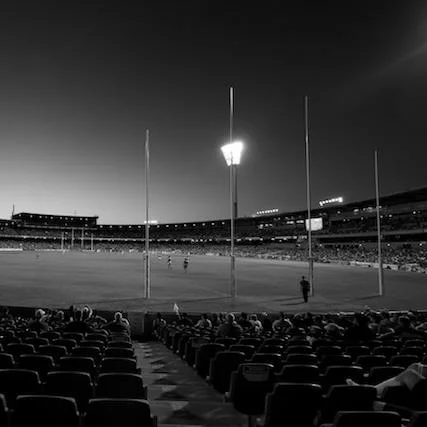
A Leader defines the Space in which those who join her will apply themselves towards the Purpose.
A Leader clearly marks out the boundaries - not as an exercise of power to restrain or control those following but as a shorthand way of defining the resources - time, money, laws, staff, decision-making authority - available to them. It removes as many variables as possible so that she can leave them to focus on doing good work.
The space is marked out in the job ad, the employment contract, the duty statement, policies, procedures, budgets. Practical, unambiguous boundary lines around a field of endeavour and creativity and good work.
A good Leader will make the space as large as practicable to allow those within it the freedom to explore and experiment and innovate.
She may have managers who patrol the boundaries on her behalf. (Many 'leadership' positions are actually caretakers of a boundary of the Space carved out by a Leader.)
Some people's response to boundaries is to run as fast as they can to the extremes of the space and pound on the walls. A few will even cross over them as a child-like expression of their independence or dissent from the Leader. Others will probe the boundaries for technical gaps and exploit them, only to retreat back inside and feign surprise and indignation when asked to account by the managers for their actions.
The Leader responds by inviting them to leave her space and create their own.
As she will soon do herself.
The Leader's final act is to Retreat from the Space that she has created for others to fill.
So that she can define a new one.
And so on.
Because that's what Leaders do.
Labels.

I was ranting to Jonathon about how poorly most organisations deal with complaints. I took him through my argument.
A good decision is one that advances us towards where we want to be.
It demands that we remain open to information that may orientate us about where we are in relation to where we want to be.
If we are clear about our Widget.
And authentic in our desire to become who we are.
We should eagerly, actively and greedily seize on any information that helps us to orientate ourselves in relation to our objectives.
One of the biggest obstacles that we have to good decision making is the label that we put on information before we have assessed it.
'Complaint' is the best example.
Call something a 'Complaint' and our ego hears a call to arms. It activates the equivalent of a bank teller security screen. Zip - up go our defences.
We look for reasons to dismiss the complaint, or at least filter out the information.
It's anonymous.
It's not in writing.
It hasn't come through the right channels.
The complainant said that they don't want us to do anything about it.
We're like children searching to legitimise not eating our greens.
Then Jonathon says: 'Imagine if a car pulled up alongside you at the traffic lights, sounded their horn to get your attention, and the passenger rolled down their window and pointed at your rear tyre and then drove off when the lights turned green. Would you ignore their signal because they're anonymous? Would you look away because their information was in the form of gestures and not in writing?
Complaints are just information in an emotional wrapper.